

Everything Is Normal

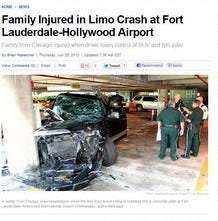
Trish and I took two of our three kids to Florida for a late-June getaway. When we arrived at the Fort Lauderdale airport, our driver met us at baggage claim holding a sign that read, “Welcome Rothschild Family.” Given that our plane was two hours late, I was relieved it didn’t say, “Where the hell have you been?”
The driver told us he was retired but worked this route a few days a week to get out of the house. We buckled up, and he pulled out of the top floor of the garage at breakneck speed. Trish said, “Don’t be funny,” and I said, “slow down, we’re all good,” thinking he was trying to seem cool for the kids. He sped up even more and I yelled, “What are you doing?” He screamed, “Oh my God, the car won’t stop, oh my God.”
He swerved left around the corner, and I was sure we were going to fly off the side of the building. Instead, he aimed toward the parked cars, and we smashed into a cement pylon. His airbag popped and I blacked out.
I woke up and heard our eight-year-old daughter Hannah screaming from the third row. Trish was crumpled on the car floor beside me, holding her stomach. A crowd gathered around the car. I tried to get out, but the door wouldn’t budge. People outside pulled me away. I tried to speak, but my words came out wrong. I heard myself say, “my words are slurry.” The paramedics arrived and I became fixated on finding my phone, which flew out of my hands in the crash. “My fo!” I cried.
This is not the hero moment I would have hoped for. In my mind, I would stop at nothing to save my family, but on the garage floor, I was immobile and worried about my iPhone.
Hannah and Trish were brought to the ground a few feet away from me, shaking and crying. I tried to calm them and said, “You okay, we fine, this normo.” I hollered to Alex, who I still couldn’t see. “Alex, this normo. We okay.”
This wasn’t the first time I’d tried to manage danger. I’m proud of that part of myself. It’s also a weakness.
I have a habit of normalizing the abnormal. I do it to keep people calm and to feel in control. I do it in business when things wobble that I know will steady. I normalize world events too. It isn’t denial so much as triage. People scare easily, and my reminding them that most crises pass can be calming, even kind.
Most of the time, it works. And because I assume people expect me to be the steady one, I trusted it here too.
The paramedics put me on a stretcher, taped my head down and brought me into the ambulance. “I fine,” I protested. They brought in Hannah next, thank God not on a stretcher. They cut my pant leg open and I said, “But they’re new,” which I felt they should know.
When we arrived at the hospital, they took Hannah to the children’s ward and wheeled me in another direction. After a young doctor shined a flashlight into my eyes, she asked me to stand up, and I collapsed to the floor. My pelvis had been shattered but no one thought to look.
I understood then that nothing was normo. Not even close.
A nurse came by and said Alex and Hannah were together in the children’s section with minor abrasions, but Trish was in emergency surgery. Her colon had been split open by her seatbelt. I flashed back to her sitting on the car floor, holding her stomach. She would live, they assured me, as if the thought even crossed my mind, but she might come out with a colostomy bag and there could be other issues. I couldn’t comprehend what they were saying and began to hyperventilate. I said, “but we’re on vacation,” as if that had any meaning. I was holding on to a reality that already died.
They put me in a wheelchair and took me to the children’s section. Alex and Hannah were together, scraped up but intact. While I was still trying to process what had happened, I found Alex already messaging family friends about the accident. He’d even tracked down neighbors on vacation nearby who could take care of him and Hannah in the morning.
I called a car to take the kids to a hotel, but Hannah wouldn’t get in at first, she was still in panic. We went less than ten miles an hour for the entire ride. When we arrived, I put them in front of the TV and headed back to the hospital. Hannah asked if I would bring Mom back with me and I said “maybe,” the kind of answer adults give to children when the truth feels unbearable. We both knew I was lying.
And I had no idea how much worse things were about to get.
Trish’s sister flew in to help the next day, and her husband took the kids back to Chicago. I left a few days after that to be with them, pushed through the airport in a wheelchair. When we got to the gate, the agent asked, “Did you have a nice visit?”
To my shock, I said “yes.”
Trish struggled in the hospital and seemed to be getting worse, but her doctors said everything was normal. A few doctors even made her feel bad for questioning them. One said, “You don’t ask a pilot how they fly the plane, do you?”
After a week in the hospital, Trish got shocking news. A night nurse came in, closed the door behind her, and said, “I could get fired for saying this, but there’s something wrong that they’re not telling you. I’d get the hell out of here if I were you.” Trish said the nurse sounded afraid for her, like she might die if she stayed there any longer. When Trish woke up the next morning she had to think hard to recall if the nurse was real or a dream.
We jumped into action the next morning. I found a private medivac plane service, and we flew Trish home to a Chicago hospital, where she stayed for another week. The doctors eventually discovered that her emergency surgery in Florida had been botched. There was an obstruction in her colon which they repaired. It saved her life.
We spent the rest of the summer healing.
As I think back to the accident, I understand that I wasn’t trying to be a hero in that garage. I was trying to be a stabilizer. I couldn’t fix what was broken, so I reached for my go to: calm. There are moments when that instinct is useful and keeps people from falling apart. And there are moments when it becomes a way of not seeing what’s right in front of you.
The night nurse didn’t try to soothe or reassure. She didn’t say everything was normal. She broke the spell. I don’t know her name and never will, but I know this: Trish is alive because someone was willing to interrupt the lie.
I’ve spent much of my life trying to steady people by telling them things are fine. Knowing when that’s true matters more than sounding calm.
Life is rarely normal. We’re lucky when someone risks saying so out loud.
.
Wow- what a harrowing time for you all :( I remember it well and am so so happy you all recovered
I didn’t know about the nurse ! What a god send ♥️
Unbelievable story. Thankful you all survived. And for the nurse 🙏 Of course I want to know all about the lawsuits / claims… And I admit I hysterically laughed when I read the line about saying yes when asked if you had a nice stay 😂